Skating Merit Badge
Overview
This merit badge introduces Scouts to the exciting world of ice skating, roller skating, in-line skating, and skateboarding. In addition to being an enjoyable leisure activity that promotes fitness, there are a variety of athletic careers in skating.
Requirements
- (1) Do the following:
-
(a) Explain to your counselor the most likely hazards associated with skating and what you should do to anticipate, help prevent, mitigate, and respond to these hazards.
Resources: Skateboard Safety (website)
-
(b) Show that you know first aid for injuries or illnesses that could occur while skating, including hypothermia, frostbite, lacerations, abrasions, fractures, sprains and strains, concussions, blisters, heat-related reactions, and shock.
Resources: Skating Injuries - Types and Prevention (website)
-
- (2) Working under the supervision of an experienced adult, do ONE of the following options:
-
Option A—Ice Skating. Do ALL of the following:
Resources: How To Figure Skate (video), How To Ice Skate (video)
-
(1) Explain the general safety and courtesy guidelines for ice skating.
Resources: Safe Skating Rules (website)
-
(2) Discuss preparations that must be taken when skating outdoors on natural ice. Explain how to make an ice rescue.
Resources: How To Know if Ice Is Safe To Walk On (video), Ice Safety (website), Test Ice Thickness (video), How To Save Someone Who Falls Through Ice (video)
-
(3) Discuss the parts and functions of the different types of ice skates.
Resources: Figure Skates vs. Hockey Skates (video)
-
(4) Describe the proper way to carry ice skates at the rink and for travel.
Resources: How To Carry Ice Skates (PDF)
-
(5) Describe how to store ice skates for long periods of time, such as seasonal storage.
Resources: Care for Your Ice Skates (website)
-
(6) Skate forward at least 40 feet and come to a complete stop. Use either a two-foot snowplow stop or a one-foot snowplow stop.
Resources: Snowplow Stop (video)
-
(7) After skating forward, glide forward on two feet, then on one foot, first right and then left.
Resources: Forward Stroking (video)
-
(8) Starting from a T position, stroke forward around the test area, avoiding the use of toe picks if wearing figure skates.
Resources: Forward From a T Position (video)
-
(9) Glide backward on two feet for at least two times the skater’s height.
Resources: Skate Backward (video)
- (10) Skate backward for at least 20 feet on two skates.
-
(11) After gaining forward speed, glide forward on two feet, making a turn of 180 degrees around a cone, first to the right and then to the left.
Resources: Turns Around a Cone (video)
-
(12) Perform forward crossovers in a figure-eight pattern.
Resources: How To Do Front Crossovers in a Figure 8 (video), How To Do Back Crossovers in a Figure 8 (video)
-
(13) Explain to your counselor the safety considerations for participating in an ice-skating race.
Resources: How Speed Skaters Stay Safe on the Ice (website), Safety Tips: Ice Skating (website)
-
(14) Perform a hockey stop.
Resources: Perform a Hockey Stop (video)
-
- Option B—Roller Skating. Do ALL of the following:
-
(1) Explain the general safety rules and etiquette guidelines for roller skating.
Resources: Getting Started with Roller Skating (video)
- (2) Discuss the parts of a roller skate and their functions.
- (3) Describe five essential steps to good roller skate care.
-
(4) Skate forward with smooth, linked strokes on two feet for at least 100 feet in both directions around the rink and demonstrate proper techniques for stopping.
Resources: Skating Forward (video)
- (5) Skate forward and glide at least 15 feet on one skate, then on the other skate.
-
(6) Perform a forward crossover.
Resources: Skating Crossovers (video)
-
(7) Skate backward for at least 40 feet on two skates, then for at least 15 feet on one skate.
Resources: Roller Skating Backwards (video)
- (8) Skate forward in a slalom pattern for at least 40 feet on two skates, then for at least 20 feet on one skate.
- (9) Skate backward in a slalom pattern for at least 15 feet on two skates.
- (10) Shuttle skate once around the rink, bending twice along the way, without stopping.
-
(11) Perform a series of two consecutive spins on skates, OR hop, skip, and jump on skates for at least 10 feet.
Resources: Roller Skating Two-Foot Spins (video)
- (12) Perform a stepover.
- (13) While skating, dribble a basketball at least 40 feet, then back to your starting position, OR push a hockey ball with a stick at least 40 feet, then back to your starting position.
-
- Option C—In-Line Skating. Do ALL of the following:
-
(1) Explain the general safety rules and courtesy guidelines for in-line skating.
-
(2) Describe the parts of an in-line skate and their functions.
Resources: Types and Parts of Inline Skates (video)
-
(3) Describe the required and recommended safety equipment for in-line skating.
Resources: Safety Gear for In-Line Skating (video), Putting on Your Protective Gear (video)
-
(4) Explain four essential steps to good in-line skate care.
Resources: Maintaining and Caring for Your In-Line Skates (video), Cleaning Your In-Line Skates (video)
-
(5) Skate forward with smooth, linked strokes on two feet for at least 100 feet.
Resources: Skating Forward (video)
-
(6) Skate forward and glide at least 15 feet on one skate, then on the other skate.
Resources: Gliding on One Skate (video)
-
(7) Stop on command on flat pavement using the heel brake.
Resources: Braking with In-Line Skates (video)
-
(8) Perform a forward crossover.
Resources: How To Turn on In-Line Skates (video), 5 Steps to the Perfect Crossover (video)
-
(9) Perform a series of forward, linked swizzles for at least 40 feet.
Resources: Forward Swizzles (video)
-
(10) Skate backward for at least 40 feet in a series of linked, backward swizzles.
Resources: Backward Swizzles (video)
-
(11) From a strong pace, perform a lunge turn around an object predetermined by your counselor.
Resources: Maneuvering Around Objects (video)
-
(12) Perform a mohawk.
Resources: Perform a Mohawk (video)
-
(13) Perform a series of at least four one-footed downhill slaloms on pavement with a gentle slope.
Resources: One-Footed Slalom (video)
-
(14) Describe how to pass a pedestrian or another skater from behind.
Resources: Passing Another Skater (PDF)
-
(15) Describe at least three ways to avoid an unforeseen obstacle while skating.
Resources: In-Line Skating Safety (video)
-
(16) Describe two ways to get on and off a curb, and demonstrate at least one of these methods.
Resources: Maneuvering Curbs (video)
-
-
Option D—Skateboarding. Do ALL of the following:
Resources: Jamboree - The Park (video)
-
(1) Explain the history and evolution of skateboarding.
Resources: How Has Skateboarding Changed Over the Years (video), The Wild History of Skateboarding (video), The Evolution of Skateboard Tricks! (video)
-
(2) Describe the benefits of skateboarding (physical fitness, balance, coordination, perseverance, and creativity).
Resources: Benefits of Skateboarding (video), Physics of Skateboarding (video)
-
(3) Explain the safety rules and courtesy guidelines for skateboarding, including right-of-way and communication signals and warnings.
Resources: Skate Park Safety Rules (video), How To Ride Skateparks for Beginners (video), Skatepark Terrain (video), How To Ride Safely on a Skateboard (video), Passing Another Skateboarder (PDF)
-
(4) Explain the protective gear needed to skate safely, including helmet, knee pads, elbow pads, and wrist guards, and show how to wear them correctly.
Resources: Skateboarding Safety (website)
- (5) Describe the two main styles of skateboarding (street and vert), and describe common skatepark features (ramps, manual pad, rails, spine, etc.).
-
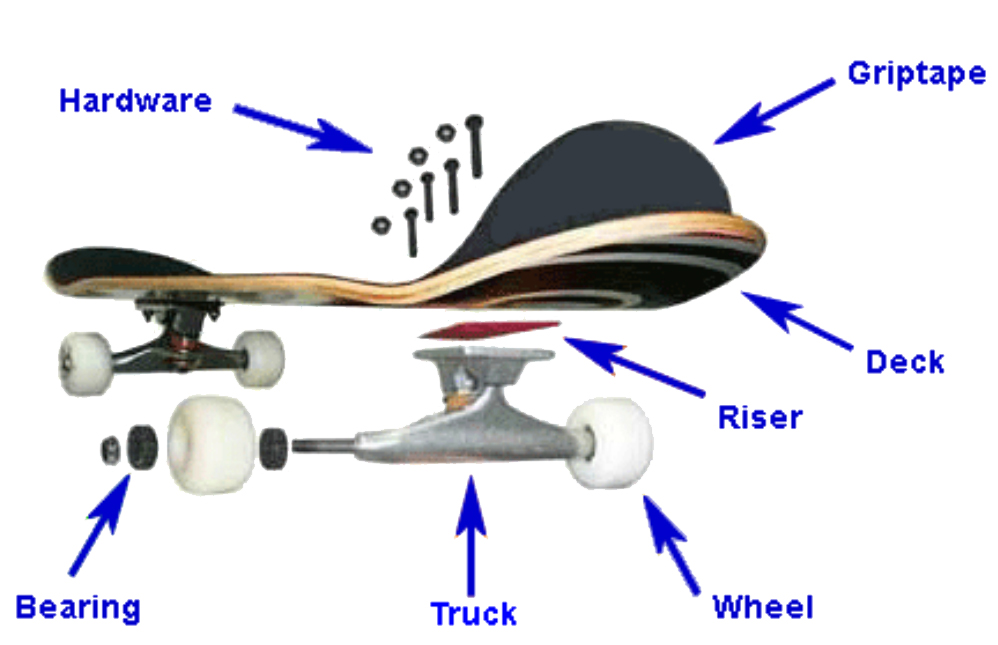
(6) Explain skateboard anatomy (deck, trucks, wheels, hardware, etc.).
Resources: How To Select a Skateboard (video)
-
(7) Build a board by assembling all pieces (deck, wheels, trucks, hardware, and grip tape) in the proper order.
Resources: How To Assemble a Skateboard (video), Parts of a Skateboard (video)
-
(8) Explain skateboard maintenance (cleaning, adjusting bolts, and replacing parts).
Resources: How To Maintain Your Skateboard (website)
-
(9) Explain the difference between regular and goofy stance, and demonstrate your preferred stance.
Resources: Goofy vs. Regular Stance (video)
-
(10) Demonstrate how to push, cruise, and carve on flat ground.
Resources: How To Push on a Skateboard (video), How To Turn on a Skateboard (video)
-
(11) Show at least two braking and stopping techniques.
Resources: How To Stop a Skateboard (video)
-
(12) Do a basic ollie and at least one variation.
Resources: How To Ollie on Skateboard (video)
- (13) Show how to drop-in from coping.
- (14) Demonstrate THREE skateboarding tricks from the following types:
-
(a) Flat ground tricks
Resources: Flatland Tricks (video), How To Manual on Skateboard (video), How To Throwdown on Skateboard (video), How To 180 on a Skateboard (video)
-
(b) Flip and shove-it tricks
Resources: Flip a Skateboard (video), Shove-It (video)
-
(c) Grind and slide tricks
Resources: Grind Tricks (video), Doing a Slide (video)
-
(d) Air and grab tricks
Resources: Frontside Air (video), Grab Tricks (video)
-
(e) Footplant tricks
Resources: How To Boneless (video)
-
-
-
Resources
- Skating merit badge page
- Skating merit badge PDF (local copy)
- Skating merit badge pamphlet
- Skating merit badge workbook PDF
- Skating merit badge workbook DOCX
Note: This is an unofficial archive of Scouts BSA Merit Badges that was automatically extracted from the Scouting America website and may contain errors.