Rowing Merit Badge
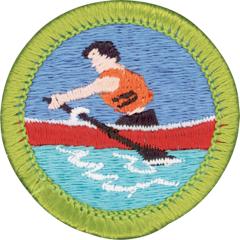
Overview
Rowing is the use of oars as a means of propelling boats, has grown from a basic method of transportation to a competitive sport and an enjoyable method of exercising.
Requirements
- (1) Do the following:
-
(a) Explain to your counselor the most likely hazards you may encounter while participating in rowing activities, including weather- and water-related hazards, and what you should do to anticipate, help prevent, mitigate, and respond to these hazards.
Resources: 5 Common Rowing Injuries and How To Prevent and Treat Them (video), The Dangers of Cold Water Immersion (video), How To Stay Safe When Paddling (video)
-
(b) Review prevention, symptoms, and first-aid treatment for the following injuries or illnesses that can occur while rowing: blisters, hypothermia, heat-related illnesses, dehydration, sunburn, sprains, and strains.
Resources: How To Prevent and Treat Blisters (website), OSHA Heat Illness Prevention Campaign (video), What Happens if You Don’t Drink Enough Water? Signs of Dehydration + 4 Ways To Keep Hydrated (video), Mayo Clinic Minute—Dangers of Heat-Related Illnesses (video), What Causes Sunburns? (video), Sprain or Strain: What To Do (video)
-
(c) Review the Scouting America Safety Afloat policy. Explain to your counselor how this applies to rowing activities.
Resources: Safety Afloat (website)
-
-
(2) Before completing requirements 4, 5, 6, and 7, successfully complete the Scouting America swimmer test. Note: See the Swimming merit badge pamphlet for details about the Scouting America swimmer test.
Resources: Swimming Merit Badge Pamphlet (PDF)
-
(3) Review the characteristics of life jackets most appropriate for rowing and why one must always be worn while rowing. Then demonstrate how to select and fit a life jacket.
Resources: How To Choose the Right Life Jacket (video)
- (4) Do ONE of the following:
- (a) Alone or with a passenger, do the following in either a fixed-seat or sliding-seat rowboat:
- (1) Launch.
-
(2) Row in a straight line for 100 yards. Stop, pivot, and return to the starting point.
Resources: How To Row Properly (video), Rowing Technique: Mastering Oar Placement for Boat Speed (video)
- (3) Backwater in a straight line for 25 yards. Make a turn underway and return to the starting point.
- (4) Land and moor or rack your craft.
-
(5) Tie the following mooring knots—clove hitch, roundturn with two half-hitches, bowline, Wellman’s knot, and mooring hitch.
Resources: Essential Sailing Knots Tutorial: How To Tie Bowline, Reef Knot, Clove Hitch & More (video), Mooring Hitch Knot | How To Tie a Mooring Hitch (video), Rowing and Sailing Knots (PDF)
- (b) Participate as a rowing team member in a competitive rowing meet. The team may be sponsored by a school, club, or Scout unit. The meet must include competition between two or more teams with different sponsors. Complete at least 10 hours of team practice prior to the meet.
- (a) Alone or with a passenger, do the following in either a fixed-seat or sliding-seat rowboat:
- (5) Do ONE of the following:
- (a) In a fixed-seat rowboat, come alongside a pier and help a passenger into the boat. Pull away from the pier, change positions with your passenger, and demonstrate sculling over the stern or side. Resume your rowing position, return alongside the pier, and help your passenger out of the boat.
- (b) In a sliding-seat rowboat, come alongside a pier and, with your buddy assisting you, get out onto the pier. Help your buddy into the boat. Reverse roles with your buddy and repeat the procedure.
-
(6) Participate in a swamped boat drill including righting and stabilizing the craft, reboarding in deep water, and making headway. Tell why you should stay with a swamped boat.
-
(7) Alone in a rowboat, push off from the shore or a pier. Row 20 yards to a swimmer. While giving instructions to the swimmer, pivot the boat so that the swimmer can hold on to the stern. Tow the swimmer to shore.
Resources: Row Rescue (video)
- (8) Describe the following:
-
(a) Types of craft used in commercial, competitive, and recreational rowing
Resources: 8 Things to Know Before You Buy a Rowing Boat (video)
-
(b) Four common boatbuilding materials. Give some positive and negative points of each
Resources: Boat Building Basics: Fiberglass, Resin, Composites And Cores (website/videos)
-
(c) Types of oarlocks used in competitive and recreational rowing
Resources: Oars, Oarlocks, and Rowing (website)
-
- (9) Discuss the following:
-
(a) The advantage of feathering oars while rowing
Resources: Squaring and Feathering an Oar in Rowing (video), Master the Perfect Rowing Technique: Feathering Explained (video)
- (b) Precautions regarding strong winds and heavy waves, and boat-handling procedures in rough water and windstorms
-
(c) How to properly fit out and maintain a boat in season, and how to prepare and store a boat for winter
Resources: What Is the Proper Storage Method for a Rowboat? (website)
-
(d) How to determine the proper length of oars
Resources: Oar Length and Adjustment (video)
- (e) The differences between fixed-seat and sliding-seat rowing
- (f) The different meanings of the term sculling in fixed- and sliding-seat rowing
-
(g) The health benefits from rowing for exercise
Resources: Why Is Rowing Good for You? The Full-Body Benefits (website), Scenic Rowing: Stunning Loch Lubnaig in Scotland (video)
-
Resources
- Rowing merit badge page
- Rowing merit badge PDF (local copy)
- Rowing merit badge pamphlet
- Rowing merit badge workbook PDF
- Rowing merit badge workbook DOCX
Note: This is an unofficial archive of Scouts BSA Merit Badges that was automatically extracted from the Scouting America website and may contain errors.