Radio Merit Badge
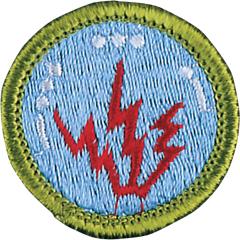
Overview
Radio is a way to send information, or communications, from one place to another. Broadcasting includes both one-way radio (a person hears the information but can¹t reply) as well as two-way radio (where the same person can both receive and send messages).
Requirements
- (1) Radio Safety. Explain the safety precautions for working with radio gear, including:
-
(a) Grounding for direct and alternating current circuits, power outlets, antennas, and lightning.
Resources: Grounding Explained (video), What Is Ground? (video)
-
(b) Preventing and treating electrical burns
Resources: First Aid for Electrical Burns (website), Rescue and First Aid for Electric Shock (video)
-
(c) Preventing lithium-ion battery fires in cell phones and other devices.
Resources: Preventing Lithium Ion Battery Fires (video)
-
- (2) Radio Fundamentals. Do the following:
- (a) Do the following:
-
(1) Draw a chart of the electromagnetic spectrum covering 300 kilohertz (kHz) to 3,000 megahertz (MHz).
Resources: Frequency Bands (video)
-
(2) Label the MF, HF, VHF, UHF, and microwave portions of the spectrum on your diagram.
Resources: Radio Frequency Bands (video)
-
(3) Locate on your chart at least eight radio services, such as AM and FM commercial broadcast, citizens band (CB), television, amateur radio (at least four amateur radio bands), public service (police and fire), cellular, Wi-Fi, and Bluetooth.
Resources: Common Uses of Ham Radio Frequencies (video)
-
- (b) Discuss the following topics with your counselor:
-
(1) The definition of radio
Resources: Communication and Radio (video), What Is a Radio Wave? (video)
-
(2) The differences between broadcast radio and two-way radio
Resources: How Broadcast Radio Works (video), Two-Way Radios Explained: VHF vs UHF, FCC Licenses, and More FAQs (video)
-
(3) The differences between commercial broadcast radio and hobby radio
Resources: What Is Ham Radio? How Amateur Radio Works (No Internet Required) (video)
-
- (a) Do the following:
- (3) How Radio Waves Travel. Do the following:
-
(a) Sketch a diagram showing how different radio wavelengths can travel locally or around the world.
Resources: What Is Propagation? (video), Why Some AM Radio Stations Don’t Work at Night (video)
-
(b) Explain how the radio stations WWV and WWVH can be used to help determine what you can expect to hear when you listen to a shortwave radio.
Resources: WWV WWVH Time Signals (video)
-
(c) Explain the difference between a distant (DX) and a local station.
Resources: DXing: D for Distance, X for Unknown (video), Ham Radio DX Fun (video)
-
- (4) Information by Radio. Discuss the following with your counselor:
-
(a) How radio waves carry information using continuous wave (CW) Morse Code transmission, amplitude modulation (AM), frequency modulation (FM), single sideband (SSB) transmission, and frequency hopping.
Resources: Radio Wave Modulation (video), Frequency Hopping (video), Frequency Hopping and WiFi (video)
-
(b) How digitized radio standards including Bluetooth, Wi-Fi, and 5G can offer more reliable data transmission and reception than analog standards.
Resources: Analog vs Digital Data (video), Digital vs Analog. What’s the Difference? Why Does It Matter? (video), Analog vs Digital Radio: A Beginner’s Guide to Radio Modes (video)
-
(c) How the effective range varies for different methods of information encoding.
Resources: Relationship Between Frequency, Data Rate, and Distance (video), How Radio Waves Transmit Information (video)
-
(d) How the maximum data rate from a Wi-Fi radio system compares to a hard-wired or fiber-optic system.
Resources: Ethernet vs WiFi, Which One Is Faster? (video), Shattering Limits: 402 Terabits per Second (video)
-
- (5) Radio Hardware and Services. Do the following:
-
(a) Explain the differences between a block diagram and a schematic diagram.
Resources: How To Read a Schematic (video)
- (b) Draw a block diagram for a radio station that shows a microphone, speaker, transceiver, transmitter, receiver, amplifier, feedline, and antenna and discuss the function of these components.
-
(c) List consumer devices and services that use analog or digital radio communications.
Resources: Analog vs Digital Radio: A Beginner’s Guide to Radio Modes (video)
-
(d) Explain how NOAA Weather Radio (NWR) can alert you to danger.
Resources: National Weather Service: Weather Warning Process (video), Ways To Get Warnings (video)
-
(e) Explain how RFID works and what are some of its uses in everyday life.
Resources: What Is RFID Technology? And How It Works? (video), What is RFID (Radio Frequency Identification)? (video)
-
- (6) Radio Regulation. Discuss the following with your counselor:
-
(a) What the Federal Communications Commission (FCC) does and how it is different from the International Telecommunication Union (ITU).
Resources: What Is the FCC? (video)
-
(b) How radio station call signs are used in broadcast radio and amateur radio.
Resources: Ham Radio Call Signs (video), Ham 101 Episode 7: Your Call Sign (video), Broadcast Call Signs Explained (video), When To ID With Your Call Sign (video)
-
(c) How the phonetic alphabet is used to communicate clearly.
Resources: Learn the Phonetic Alphabet (video)
-
- (7) Cell Phones. Do the following:
-
(a) Explain how cellular systems differ from broadcast and hobby radio.
Resources: How Your Mobile Phone Works (video)
-
(b) Explain what Airplane Mode is and why it is important.
Resources: What Really Happens When You Turn On Airplane Mode (video), What Happens if You Don’t Put Your Phone in Airplane Mode? (video)
-
(c) Explain how cell phones keep the correct time and show locations and elevations.
Resources: How GPS Works Today (video), GPS, How Does It Work? (video)
-
(d) Explain the benefits and limitations of cell phones in emergencies.
Resources: How Reliable Are Cell Phones in an Emergency? (video), When Cell Phones Fail: Staying Connected When It Matters Most (video), We Tested the iPhone 14’s Emergency SOS via Satellite (video), Does Your Phone Have a Crash Detection Feature? (website)
-
(e) Explain wireless charging for cell phones and other devices.
Resources: How Do Wireless Phone Chargers Work? (video), How Your Phone Charges Through Thin Air (video)
-
- (8) Amateur and Professional Radio. Do ONE of the following options:
- Option A—Amateur Radio. Do ALL of the following:
-
(1) Tell why the FCC has an amateur radio service. Describe activities that amateur radio operators can do on the air, once they have earned an amateur radio license.
Resources: Why Do They Call It Ham Radio? (video), Episode 3: How To Get a Ham Radio License | Bcu Freshman Class (video)
-
(2) Explain differences between the Technician, General, and Extra Class license requirements and privileges. Explain who administers amateur radio exams.
Resources: Ham Radio License Levels (video)
-
(3) Explain at least five Q signals or amateur radio terms.
Resources: Q-Codes, Logs, and QRZ.com (video), Q-Codes and Calling CQ (video)
-
(4) Explain how you would make an emergency call on voice or Morse code.
Resources: How To Use Your VHF Marine Radio To Call for Help in a Boat Emergency (video), Ham Radio Disaster Messaging Demo (video), Using Ham Radio To Call for Help in an Emergency—What You Should Do! (video)
-
(5) Explain the differences between handheld, mobile, and base station transceivers and their uses. Explain the use of amateur radio repeaters.
Resources: How Do Repeaters Work? (video)
-
(6) Using proper call signs, Q signals, and abbreviations, carry on a 10-minute real or simulated amateur radio contact using voice, Morse code, or digital mode. Properly log the real or simulated amateur radio contact, and record the signal report. Note: Licensed amateur radio operators may substitute five QSL cards as evidence of contacts with five amateur radio operators.
-
- Option B—Radio Broadcasting. Do ALL of the following:
-
(1) Discuss with your counselor FCC broadcast regulations. Include power levels, frequencies, and the regulations for low-power stations.
Resources: How To Start a FM Radio Station! (video), In Historic Victory for Community Radio, FCC Puts 1,000 Low-Power FM Frequencies Up for Grabs (video)
-
(2) Prepare a program schedule for radio station “KBSA” of exactly one-half hour, including music, news, commercials, and proper station identification. Record your program on audiotape or in a digital audio format, using proper techniques.
Resources: Build the Best Programming for Your Radio Station! (video)
-
(3) Listen to and properly log 15 broadcast stations. Determine the program format and target audience for five of these stations.
Resources: Radio Stations Over The World (video)
-
(4) Explain to your counselor at least eight terms used in commercial broadcasting, such as segue, cut, fade, continuity, remote, Emergency Alert System, network, cue, dead air, PSA, and playlist.
Resources: Radio Broadcasting Glossary (website)
-
(5) Discuss with your counselor alternative radio platforms such as internet streaming, satellite radio, and podcasts.
Resources: Shortwave Radio Top Ten Tips for Beginners Listen to Online Receivers (video)
-
- Option C—Shortwave and Medium-Wave Listening. Do ALL of the following:
-
(1) Listen across several shortwave bands for four one-hour periods-at least one period during daylight hours and at least one period at night. Log the stations properly and locate them geographically on a map, globe, or web-based mapping service.
Resources: Unlock Shortwave Listening: Fun With HF Ham Radios (video), Incredible Shortwave Radio Stations Listing (video)
-
(2) Listen to several medium-wave stations for two one-hour periods, one period during daylight hours and one period at night. Log the stations properly and locate them on a map, globe, or web-based mapping service.
Resources: Great Mediumwave AM radio DXers resource for Finding Stations MWLIST (video)
-
(3) Compare your daytime and nighttime logs; note the frequencies on which your selected stations were loudest during each session. Explain differences in the signal strength from one period to the next.
Resources: Shortwave for Beginners Day and Night Differences in Radio Propagation of Signals (video), Understanding Daytime and Night Time Patterns To Increase Shortwave Listening Pleasure (video), Shortwave Propagation 101 Part 1 Daytime and Nighttime Propagation (video)
-
(4) Compare your medium-wave broadcast station logs and explain why some distant stations are heard at your location only during the night.
Resources: Why AM Radio Signals Propogate Farther At Night Than During the Day (video), Ground Wave Propagation / Types of Radio Waves (video)
-
(5) Demonstrate listening to a radio broadcast using a smartphone/cell phone. Include international broadcasts in your demonstration.
Resources: How To Listen to FM Radio on Android or iPhone! (video), Unlock the Hidden FM Radio in Your Android Smart Phone (video)
-
- Option D—Amateur Radio Direction Finding. Do ALL of the following:
-
(1) Describe amateur radio direction finding and explain why direction finding is important as both an activity and in competition.
Resources: Amateur Radio Foxhunting: Equipment, Techniques, & Getting Started—Ham Radio Transmitter Hunting (video), Radio Direction Finding: AKA How “They” Can Find You (video)
-
(2) Describe what frequencies and equipment are used for ARDF or fox hunting.
Resources: Ham Radio Fox Hunting 101 (video)
-
(3) Build a simple directional antenna for either of the two frequencies used in ARDF.
Resources: Two Simple Ham Radio Antennas You Can Use for Fox Hunting (video)
-
(4) Participate in a simple fox hunt using your antenna along with a provided receiver.
Resources: Ham Radio Fox Hunt? (video)
-
(5) Show, on a map, how you located the “fox” using your receiver.
-
- Option E—Family Radio Service (FRS) and General Mobile Radio Service (GMRS) Walkie Talkies. Do ALL of the following:
-
(1) Explain what the Family Radio Service (FRS) and General Mobile Radio Service (GMRS) are and how they are different from each other, from other commercial two-way radios, and from Citizens Band (CB) and amateur radio (ham).
Resources: FRS VS GMRS: A Radio Service Comparison Guide (video)
- (2) Explain each of the following for using a FRS radio or GMRS walkie talkie:
-
(a) Is any type of license needed to use these radios? If so: what kind?
Resources: Walkie Talkies—FRS vs GMRS vs Ham (video)
-
(b) What radio frequencies are used and how is information encoded?
Resources: Troubleshooting Radio Connections (video)
-
(c) How much power can be used when transmitting?
Resources: FRS vs. GMRS (video)
-
(d) What type of antenna can be used?
Resources: Differences between GMRS and FRS (video)
- (e) What is the effective range and what limits it?
- (f) What are common everyday uses for these radios?
-
(g) How can these radios be useful in an emergency?
Resources: HAM and GMRS Radios for Emergencies (video), FRS and GMRS Radio for Emergency Communications (video), The Vital Role of Ham Radio in Disaster Preparedness (video)
-
- (3) Use the FRS radios or GMRS walkie talkies with family, friends, or Scouts on a hike, at an event, or in a team game. Discuss what you learned with your counselor.
-
- Option A—Amateur Radio. Do ALL of the following:
- (9) Careers. Do ONE of the following:
-
(a) Explore careers related to radio. Research one career to learn about the training and education needed, costs, job prospects, salary, job duties, and advancement. With permission of your parent or guardian, your research methods may include an internet or library search, an interview with a professional in the field, or a visit to a location where people in this career work or train. Discuss your findings and career interest with your counselor.
Resources: How I Got That Job: Public Radio (video), Broadcast Announcers and Radio Disc Jockeys Careers (video)
-
(b) Explore how you could use radio knowledge and skills to develop a hobby or to serve as a volunteer. If possible, with permission of your parent or guardian, interview a radio hobbyist or volunteer. Research training and licensing needed, expenses, and organizations that promote or support your objectives. Discuss with your counselor what short-term and long-term goals you might have if you pursue this.
Resources: (Hobbies) Ham Radio (video), 5 MOST POPULAR Ham Radio Hobbies (video)
-
Resources
- Radio merit badge page
- Radio merit badge PDF (local copy)
- Radio merit badge pamphlet
- Radio merit badge workbook PDF
- Radio merit badge workbook DOCX
Note: This is an unofficial archive of Scouts BSA Merit Badges that was automatically extracted from the Scouting America website and may contain errors.