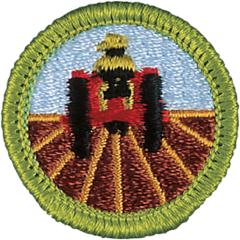
Farm Mechanics Merit Badge
Overview
From the mattock and hoe to the horse and mule, the cotton gin and reaper, the tractor and air seeder—this is the story of farm equipment. Today, most farms are mechanized and farmers can do most of their own maintenance work and make the adjustments needed on their many intricate farm implements.
Requirements
- (1) Do the following:
-
(a) Discuss with your counselor the safety equipment, tools, and clothing used while checking or repairing farm equipment. Use this equipment, tools, and/or clothing (when needed or called for) in meeting the requirements for this merit badge.
Resources: Farm Equipment Dangers —Staying Safe Around Farm Machinery (video), The Comprehensive Guide to PPE for Farmers: Safety From Head to Toe (website), Safety on the Farm: General Safety (video), Working Safely With Hand Tools Around the Farm (video), Personal Protective Equipment in the Farm (PPE) (video)
-
(b) Draw a plan showing a well-equipped farm shop. Point out the shop’s mandatory safety devices and features.
Resources: Playlist of Top Shops (playlist), Farmer’s Dream Shop Features Rolling Carts, In-Floor Tie Downs | Top Shops® | Successful Farming (video), The Largest Farm Shop We’ve Ever Seen | Top Shops® | Successful Farming (video)
-
(c) Find all the universal warning and safety symbols on a piece of equipment and explain what they mean.
Resources: Caterpillar Warning Symbols/Icons Detailed Guide (video), Agricultural Equipment Symbol Standards (website)
-
(d) Describe what a safety data sheet (SDS) is and tell why it is used. Obtain the SDS for any engine coolant, oil, grease, fuel, hydraulic or transmission fluid, or other flammable or hazardous materials you use in meeting the requirements for this merit badge.
Resources: Safety Data Sheets (video), Where to Find Safety Data Sheets (SDS): A Complete Guide (website)
-
- (2) Explain how power is produced or transferred in a:
-
(a) Diesel engine
Resources: How a Diesel Engine Works (video), How Diesel Engine Actually Works? (Animation) (video)
-
(b) Hydraulic system
Resources: How Does a Hydraulic Cylinder Work? (video)
-
(c) Transmission or any other power system
Resources: Tractor Transmission System: Common Methods (video)
-
- (3) Do TWO of the following:
-
(a) Replace the handle of any tool found on the farm.
Resources: How To Replace a Garden Tool Handle (video), Axe & Hammer Handle Replacement—How To Do It Old School (video)
-
(b) Organize a tool rack or a storage system for nails, bolts, nuts, and washers.
Resources: Adam Savage’s Hardware Logjam Sorting Challenge! (video), Easy Bolt Sorter (video), How To Organise Screws, Nails, Bolts & Nuts (video), How To Organize Your Loose Screws and Nails (video)
-
(c) Using a hand file, properly dress the mushroomed head of a chisel or punch.
Resources: 4 Tools You Can Use To Dress a Chisel (video), Dressing Hammers and Punches—Basic Blacksmithing (video)
-
(d) Using a hand file, correctly dress a screwdriver tip.
Resources: Sharpening and Reshaping Your Screwdriver With a File (video)
-
- (4) Do ONE of the following:
-
(a) On an engine-powered machine: Grease all fittings, change the oil and oil filter, clean the air filter, clean the radiator fins, and replace the fuel filters.
Resources: Do This Every Two Weeks and Your Tractor Will Never Break Down (video)
-
(b) For any engine-powered machine, create a preoperational checklist; include checking the engine coolant, engine oil, hydraulic and/or transmission fluid, and battery voltage (using a voltmeter). Using your checklist, conduct a preoperational check of that machinery or equipment.
Resources: Download Equipment and Machine Safety Checklist (PDF)
-
(c) Prepare any farm machine for winter storage.
Resources: Winterizing Your Tractor and Equipment: 10 Essential Steps (video), Preparing the Combine for Winter Storage (video)
-
-
(5) Visit an implement dealer. Interview the dealer technician or service manager for hints on good preventive maintenance. Ask why it is important, the costs, and what causes wear or damage. Report what you learn.
- (6) Explain each step in ONE of the following maintenance procedures:
-
(a) Tightening hydraulic fittings
Resources: Avoid Leaks! How To Tighten Hydraulic Fittings the Right Way (website)
-
(b) Checking the air filter
Resources: Maintaining Your Tractor—Changing the Air Filter (video)
-
(c) Cleaning a work piece with a wire-brush wheel
Resources: Cleaning Up Rusted Metal Finds (video)
-
-
(7) Find out about three career opportunities in farm mechanics. Pick one and find out the education, training, and experience required for this profession. Discuss this with your counselor, and explain why this profession might interest you.
Resources: Agricultural Engineering (video), Agriculture Careers: Agriculture Equipment Technician (video), Careers in Agriculture—Management (video), Careers in Agriculture—Technology (video), Agricultural Equipment Technician (video)
Resources
- Farm Mechanics merit badge page
- Farm Mechanics merit badge PDF (local copy)
- Farm Mechanics merit badge pamphlet
- Farm Mechanics merit badge workbook PDF
- Farm Mechanics merit badge workbook DOCX
Note: This is an unofficial archive of Scouts BSA Merit Badges that was automatically extracted from the Scouting America website and may contain errors.